Programming for Applications
Chapter 10: Object-Oriented Programming
Shih Chien University
2026-08-03
Two Object Systems
A Functional Language with OOP Support
At heart R is a functional language — and writing functional programs is fine practice. But R also supports object-oriented programming (OOP), the dominant paradigm of Java, C#, Ruby, C++… Many R packages are built with R objects, including the core stats package, lattice, and ggplot2. OOP shines when representing complicated things: statistical models, charts.
Two mechanisms coexist, both inherited from S:
- S3 (~1990): class attributes enabling single-argument methods. The classic modeling software uses S3, so it is everywhere.
- S4: formal classes and methods — multiple dispatch, abstract types, sophisticated inheritance. Used by many newer packages, extensively in Bioconductor.
The book’s advice: build new abstractions with S4; learn S3 because you must read and extend the vast code that uses it.
Key Ideas, via Time Series
A time series — equally spaced measurements over time, with a start, end, frequency — makes every OOP concept concrete:
- a class is the formal definition; each actual time series is an instance; a function operating on the class is a method;
- hiding the storage details (data frame? vector? text?) behind methods is encapsulation;
- a weight-history class that reuses the time-series machinery, adding only what differs, exhibits inheritance — time series is the superclass, weight history the subclass;
- one name (
period) doing the right thing for different classes is polymorphism; - building a class out of several component classes is composition — and inheriting from more than one class is multiple inheritance, which R permits.
(Yes, R already has a time-series class — ts, an S3 class in stats. That is deliberate: we will rebuild it the S4 way, then dissect the S3 original.)
An S4 Worked Example
setClass: Defining TimeSeries
Slots are where an object stores information. We represent a time series by three slots — the data, a start time, an end time (units, frequency, and period are derivable):
The representation names the class of object each slot holds.
new: Creating an Instance
new is the generic constructor: first argument the class name, the rest fill the slots. The default S4 print method shows every slot:
An object of class "TimeSeries"
Slot "data":
[1] 1 2 3 4 5 6

Slot "start":
[1] "2009-07-01 GMT"

Slot "end":
[1] "2009-07-01 00:05:00 GMT"
setValidity: Rejecting Bad Objects
Not all slot values make sense: end must not precede start, and both must have length 1. Register a validity function with setValidity and check with validObject:
Class "TimeSeries" [in ".GlobalEnv"]

Slots:

Name:     data   start     end
Class: numeric POSIXct POSIXct[1] TRUE(You can also supply the validity function when calling setClass — see its full definition.)
Validation in Action
From now on, new checks each candidate and rejects the invalid:
good.TimeSeries <- new("TimeSeries",
  data=c(7, 8, 9, 10, 11, 12),
  start=as.POSIXct("07/01/2009 0:06:00", tz="GMT",
                   format="%m/%d/%Y %H:%M:%S"),
  end=as.POSIXct("07/01/2009 0:11:00", tz="GMT",
                 format="%m/%d/%Y %H:%M:%S"))
bad.TimeSeries <- new("TimeSeries",
  data=c(7, 8, 9, 10, 11, 12),
  start=as.POSIXct("07/01/2009 0:06:00", tz="GMT",
                   format="%m/%d/%Y %H:%M:%S"),
  end=as.POSIXct("07/01/1999 0:11:00", tz="GMT",
                 format="%m/%d/%Y %H:%M:%S"))   # ends before it starts!
Error in `validObject()`:
! 類別為 "TimeSeries" 的物件無效: FALSEA First Method: period
A plain function that computes the period from the slots:
The @ operator reaches into slots — the implementer’s view. Users should get nicer verbs; enter generic functions.
setGeneric: series
To extract the data series from any suitable object — polymorphism — define a function and promote it to a generic; the old body becomes the default method:
[1] "series"[1] 1 2 3 4 5 6Function: series (package .GlobalEnv)
object="ANY"
object="TimeSeries"
(inherited from: object="ANY")(In OOP terms this is overloading the function name.)
setMethod: period for TimeSeries
Create a generic period, then register period.TimeSeries as its method for the TimeSeries signature:
[1] "period"Time difference of 1 minsCalling the generic dispatches to the right definition by class.
Methods for Existing Generics — Even Operators
You can attach methods to generics that already exist, like summary — or to operators:
[1] "2009-07-01 to 2009-07-01 00:05:00"
[1] "1,2,3,4,5,6"[1] 3Note
One trap: auto-printing of S4 objects goes through show(), not print — define a show method to change how objects display at the console. ?S4groupGeneric documents the group generics (Arith, Compare, Ops, …); the S3 section below explains more.
Inheritance: WeightHistory
A weight history is a time series plus a person’s name and height. contains declares the superclass; the new class adds only its extra slots:
setClass("WeightHistory",
  representation(height = "numeric", name = "character"),
  contains = "TimeSeries")
john.doe <- new("WeightHistory",
  data=c(170, 169, 171, 168, 170, 169),
  start=as.POSIXct("02/14/2009 0:00:00", tz="GMT",
                   format="%m/%d/%Y %H:%M:%S"),
  end=as.POSIXct("03/28/2009 0:00:00", tz="GMT",
                 format="%m/%d/%Y %H:%M:%S"),
  height=72, name="John Doe")
R validates the embedded TimeSeries automatically (try an invalid one yourself).
Multiple Inheritance: Person + TimeSeries
A cleaner composition: define a Person class, then inherit from both:
Identical behavior, slightly cleaner design — and AltWeightHistory now inherits methods from both parents.
Virtual Classes: setClassUnion
Add a Cat class — cats have names too. To write one is.fluffy method covering people and cats, create a virtual class above both with setClassUnion:
Methods can target NamedThing; objects cannot be created from it (its representation is ambiguous). A subclass method (say, is.fluffy for Person) would override the parent’s. Bonus — class membership is testable:
[1] TRUE[1] TRUES4 in Depth
setClass: the Full Signature
| Argument | Description |
|---|---|
Class |
name of the new class (the only required argument) |
representation |
named list of slots and their classes ("ANY" allows anything) |
prototype |
object holding default slot values |
contains |
names of superclasses this class extends |
validity |
validity-checking function (default: none; changeable via setValidity) |
where |
environment to store the definition (default: where setClass was called) |
sealed |
may the class be redefined by another setClass? |
package |
package name for the class |
S3methods |
may S3 methods be written for this class? (default FALSE) |
access, version |
unused; S-PLUS compatibility |
Helpers representation() and prototype() (in methods) ease definitions that extend a basic type, have several superclasses, or mix both.
Slot Rules, .Data, and Friends
- Forbidden slot names — reserved for attributes:
class,comment,dim,dimnames,names,row.names,tsp. (Objects can have both slots and attributes.) - Extending a basic type (the table later in this chapter) yields a
.Dataslot holding the basic part — code written for the built-in type keeps working, acting on.Data. setIs(class1, class2, ...)declares inheritance explicitly — an alternative tocontains.- On creation, R runs the class’s
initializemethod if defined — typically to compute derived slots. setClassUnion(name, members, where)creates the virtual superclass seen earlier.
New Objects and Slot Access
new(c, ...)— the constructor: named arguments fill slots; aninitializemethod (if any) runs afterward.- Reading slots:
object@slotname, or equivalentlyslot(object, "slotname"). - Writing slots uses ordinary assignment, with validity checked by default:
Working with Objects, and Coercion
Object inspection vocabulary:
is(o, c)— is objectoa member of classc?extends(c1, c2)— does classc1extendc2?slotNames(o)/slotNames(c)— slot names of an object / class;getSlots(c)— the classes of each slot (nonintuitively).
Conversion: as(o, c) coerces object o to class c. For your own classes, register coercion methods with setAs:
| Argument | Description |
|---|---|
from, to |
class names of input and output |
def |
function performing the conversion |
replace |
function for the replacement form (when as is assigned into) |
where |
environment for the definition |
setGeneric and setMethod: Full Signatures
setGeneric(name, def=, group=list(), valueClass=character(), where=, package=, signature=, useAsDefault=, ...) — key arguments:
name/def— name and optional defining function;group— group generic (see?S4groupGeneric);valueClass— class(es) the return value must belong to;signature— formal-argument names and classes ("ANY"= anything);useAsDefault— which function becomes the default method.
setMethod(f, signature=character(), definition, where=, valueClass=NULL, sealed=FALSE):
f— generic (or its name);signature— argument classes to match;definition— the function to call;sealed— prevent redefinition.
Managing Generics and Methods
Bookkeeping functions from the methods package:
| Function | Description |
|---|---|
isGeneric / isGroup |
does a generic / group generic of this name exist? |
removeGeneric / removeMethods |
remove a generic with its methods / just the methods |
getMethod, selectMethod |
fetch the method for a function + signature |
existsMethod, hasMethod |
does such a method exist? |
findMethod |
which package(s) contain it? |
showMethods |
display all methods of an S4 generic |
dumpMethod / dumpMethods |
dump one / all methods to code |
findFunction |
where on the search list a function is defined |
More help: library(help="methods").
Basic Classes
Classes of the built-in types — everything is built on these, and you may write methods for them:
| Category | Object type | Class |
|---|---|---|
| Vectors | integer / double / complex / character / logical / raw |
integer / numeric / complex / character / logical / raw |
| Compound | list / pairlist / environment |
list / pairlist / environment |
| Special | NULL |
NULL |
| Language | symbol / language / expression |
name / call / expression |
| Functions | closure / special / builtin |
function |
| Other | externalptr |
externalptr |
The six vector classes all extend the virtual class vector.
Old-School OOP: S3
S3 Classes Are Just Attributes
An S3 object is a primitive object wearing extra attributes — one of them named class. No formal definition exists; you can change the attributes by hand. (S3 resembles prototype-based languages like JavaScript.) Dissecting the built-in ts class:
     Feb Mar Apr May Jun
2009 1 2 3 4 5$tsp
[1] 2009.083 2009.417 12.000
$class
[1] "ts"[1] "double"[1] 1 2 3 4 5
attr(,"tsp")
[1] 2009.083 2009.417 12.000A ts is a double vector plus class and tsp attributes. And S4 tools don’t apply:
S3 inheritance is informal — a class attribute with several elements means the first is the class, the rest are “inherited” classes, making inheritance a property of objects, not classes. Encapsulation is unenforced; parametric polymorphism is absent. Simple polymorphism, however, works — via S3 generics.
S3 Methods: Naming Convention + UseMethod
S3 generics dispatch by naming convention, not registration:
- pick a generic name, say
gname; - define
gnamewith bodyUseMethod("gname"); - for each class, define
gname.classnamewhose first argument is such an object.
The real thing:
UseMethod walks the object’s class vector looking for plot.class; failing everything, it tries plot.default. (NextMethod, callable inside a method, hands off to the next available method.)
Adding an S3 Method to Our S4 Class
Give TimeSeries a plot method by merely naming a function correctly:
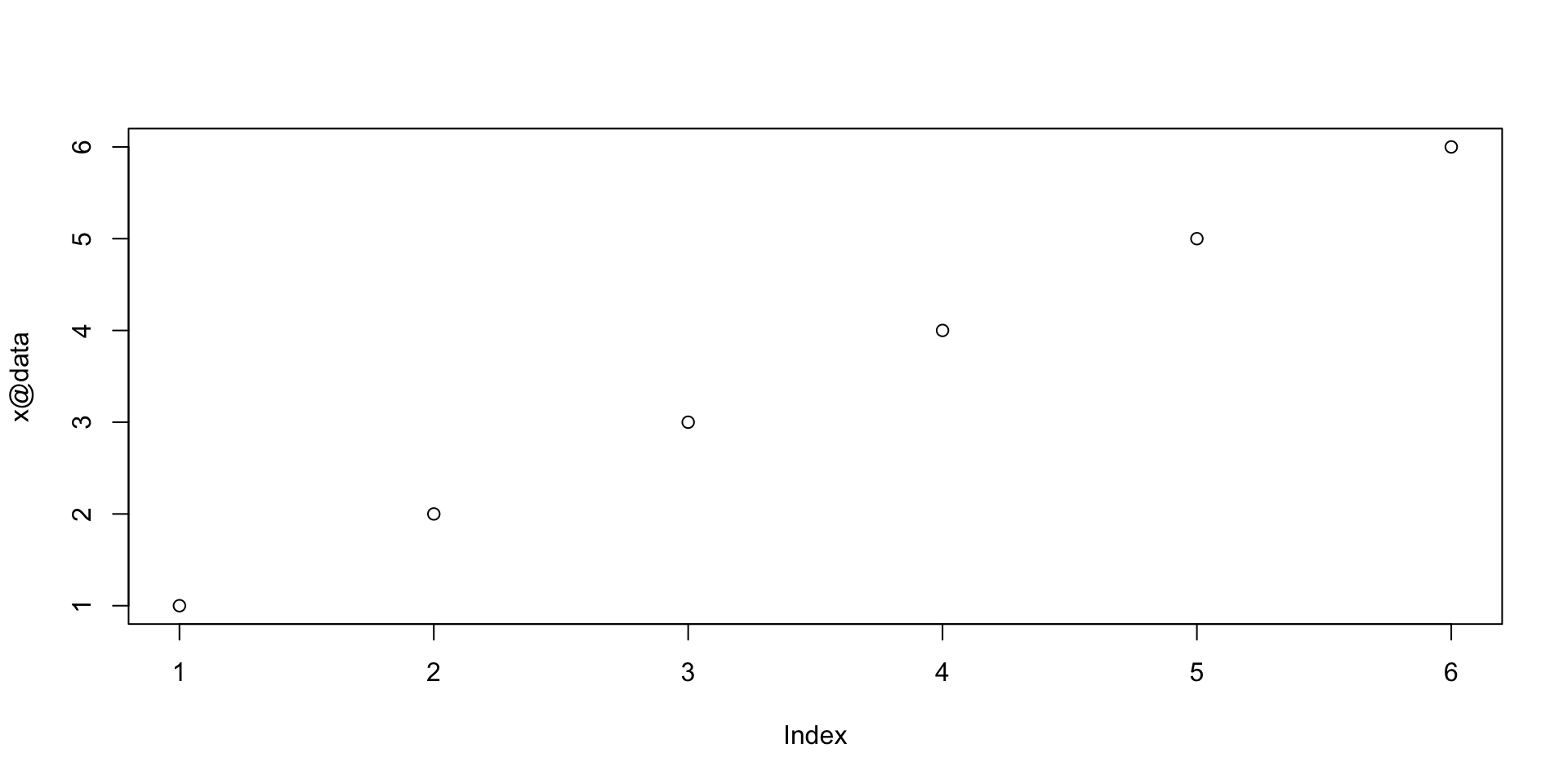
plot(my.TimeSeries) quietly becomes plot.TimeSeries(my.TimeSeries).
S3 Inside S4: setOldClass
S4 slots cannot hold an S3 class directly — first wrap it with setOldClass(Classes, prototype, where, test=FALSE, S4Class):
Classes— name(s) of the old-style class;prototype— default object for the S4 class;test— setTRUEif there can be multiple inheritance;S4Class— an S4 class definition to base the new class on.
Finding Hidden S3 Methods
Package authors may hide individual methods to push you toward the generic — encapsulation by obscurity:
[1] histogram.data.frame* histogram.factor*     histogram.formula*
[4] histogram.numeric*
see '?methods' for accessing help and source codeError in `histogram.factor()`:
! 沒有這個函式 "histogram.factor"To read the hidden code anyway:
Tip
Modern footnote. Today’s ecosystem adds further systems — R6 for mutable reference objects and S7 as the planned successor unifying S3/S4. The concepts you just learned (classes, methods, dispatch, inheritance) transfer directly.
Copyright Notice
Copyright. These slides are adapted from R in a Nutshell: A Desktop Quick Reference (2nd ed.) by Joseph Adler, O’Reilly Media. All rights reserved by the original author and publisher.
Non-commercial use only. These materials are strictly for educational purposes and may not be used for commercial gain.
Attribution. Any reproduction, distribution, or use of these materials must properly credit the original source.

R in a Nutshell: A Desktop Quick Reference